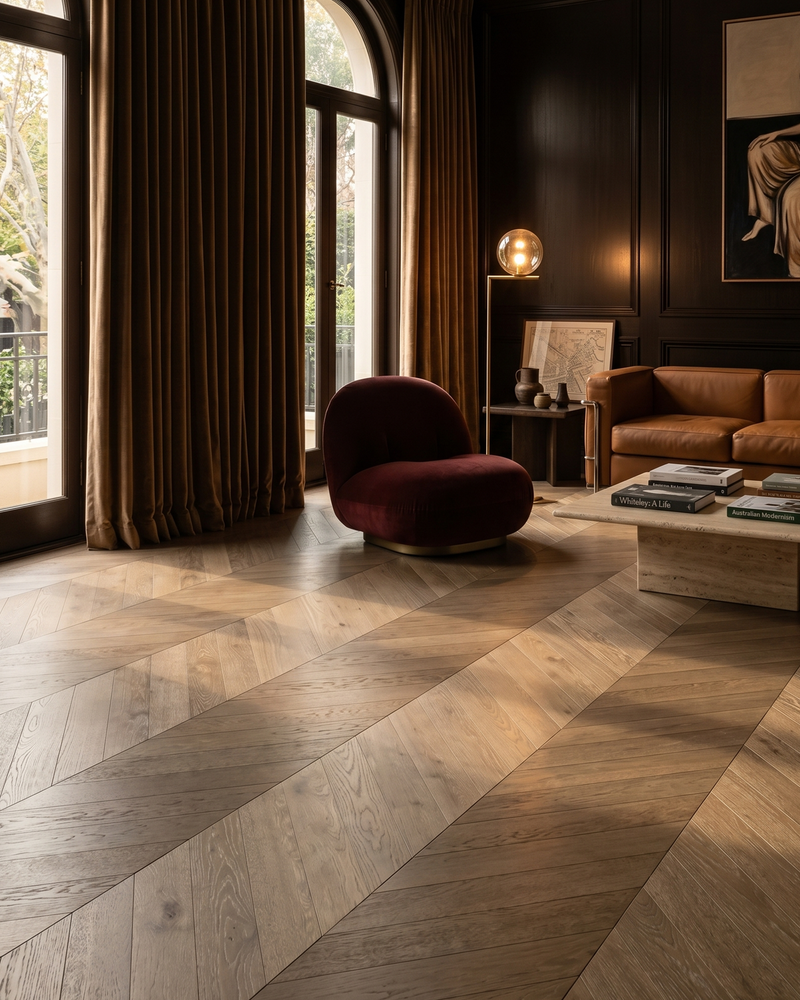
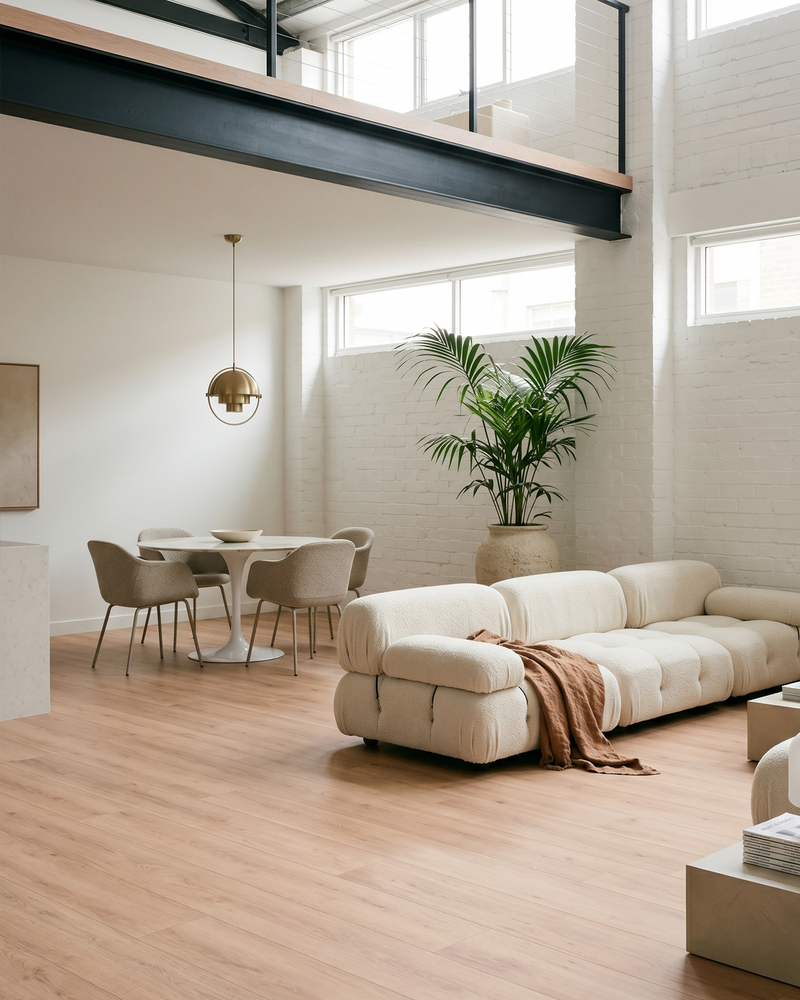
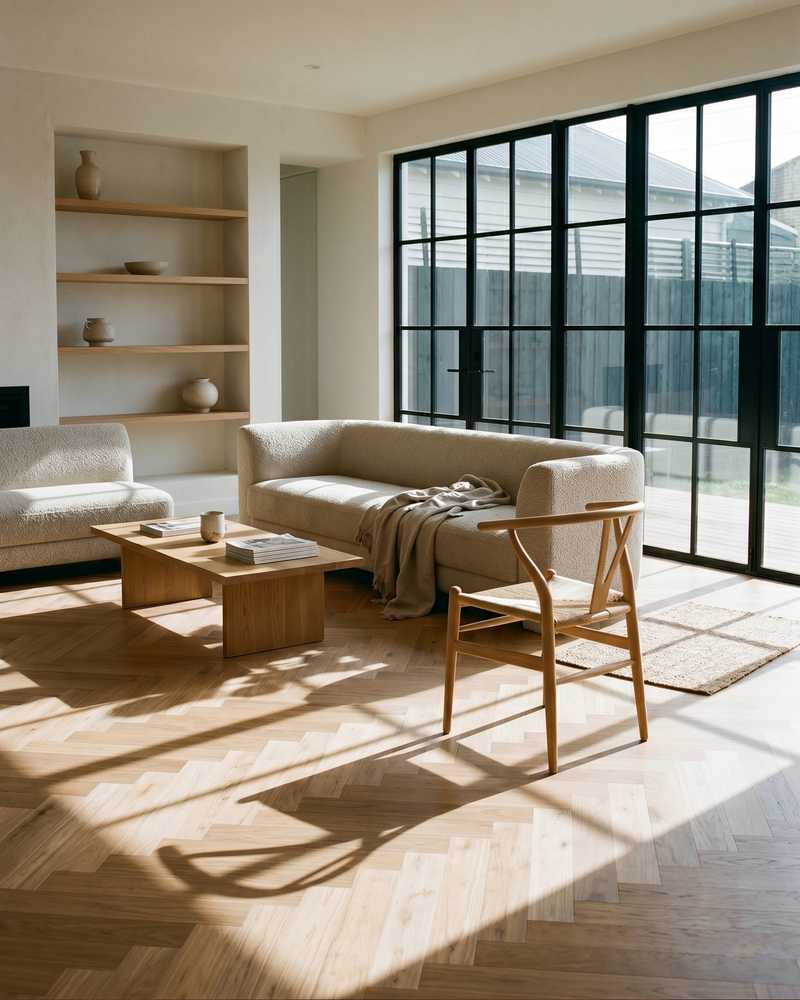
Most problems with a new floor begin before the first board is laid. Each Topdeck range has an installation guide, and they agree on the essentials: a ready site, a sound subfloor, a steady climate and room for the floor to move. This summary draws on those guides. They are a guide only; the National Construction Code, the relevant Australian Standards and trade judgement apply.
A ready site
The building is enclosed, weathertight and secure, wet trades are substantially complete and permanent climate control is running. The floor goes in late in the construction sequence, so it is protected from the trades that come before it.
A steady climate
- Rhine: 18–25°C and 40–60% relative humidity held for at least five days before installation, through the work and for the life of the floor. Unopened cartons are stored flat, fully supported and clear of concrete in the installation area for at least 24 hours.
- Provenance: 18–25°C and 40–60% relative humidity before, during and after installation, with unopened cartons stored flat, fully supported and clear of concrete.
- Heritage: supplied at an average of 10–12% moisture content and acclimatised by measurement. Moisture meter readings are checked against the expected in-service conditions, and acclimatisation may not be necessary where they already match.
- Pantora and Prime Laminate: unopened cartons stored flat in the room for at least 48 hours, and 18–30°C and 30–70% relative humidity before, during and after installation.
- Core hybrid: boxes acclimatised unopened in the installation area for 24 hours, with optimal conditions of 18–30°C and 30–70% relative humidity, and the space kept between 3°C and 50°C at all times.
A sound subfloor
The substrate is structurally sound, rigid, dry, clean and flat, and it is tested and recorded before a carton is opened. The Rhine guide gives the Australian Timber Flooring Association (ATFA) defaults:
- Flatness: no more than a 3mm gap under a 3m straightedge on concrete, and 3mm under 1.5m on new sheet, batten or joist substrates.
- Concrete moisture: a dry slab reads up to 2.0% on an impedance meter and up to 75% in-slab relative humidity; higher readings are investigated.
- Timber and sheet substrates: dry and at equilibrium with the expected conditions, with timber moisture content no higher than 11%.
An adhesive-fixed floor over a slab also needs an approved moisture-vapour-retarding system.
The right method
- Heritage is fixed by board width: secret nail and glue for 80–90mm boards, full trowel glue and secret nail for 92–130mm. It is never floated.
- Rhine plank is glued down, or floated on an approved underlay with glued tongue-and-groove joints where the room and subfloor suit.
- Provenance plank is floated on an approved acoustic underlay, or laid by full-spread direct stick.
- Herringbone and chevron in Rhine and Provenance are full-spread adhesive-fixed by a professional timber-floor installer.
- Pantora and Prime Laminate are floating click floors, never glued or nailed down.
- Core hybrid is floating only; glue-down is not recommended except on staircases. Belle Vie herringbone also floats, laid from starting triangles set out from the centre of the room.
Room to move
Every floor keeps a clear gap at the walls and around fixed objects: 8–15mm for Rhine, a minimum of 10mm for Heritage, and 8–10mm for Pantora and Prime Laminate. Skirting and scotia are fixed to the wall, never through the floor, and required gaps are never filled with rigid filler, adhesive or fasteners.
Floating floors also have run limits, at which an expansion break is installed:
- Rhine, floated: 9m across the board width and 12m along its length.
- Provenance, floated: 8m in either direction, unless Topdeck gives a larger written allowance.
- Prime Laminate Deluxe, Contemporary Plus and Luxury Editions: 9m across the plank width or 12m along its length. Legend Collection: 12m and 18m.
- Pantora: 15m across the plank width or 18m along its length.
Heritage runs over 6m in width need an intermediate expansion joint. Cabinetry and fixed joinery go in before a floating floor, never on top of it.
Underfloor heating
The Topdeck Limited Warranty lists underfloor heating as not suitable for Heritage and Provenance, and excludes floor heating other than hydronic heated slabs for Rhine. It does not recommend underfloor heating for Pantora, Prime Laminate or hybrid floors. A heated floor is raised with Topdeck before anything is specified.
Ordering
The guides allow at least 5–7% for cutting waste in a regular plank layout, 12–13% for a diagonal layout, at least 20% for herringbone or chevron, and around 10% for Pantora. Irregular rooms, selective grading and colour blending may need more.
Keeping a record
The Rhine guide asks the installer to record the product and batch, room climate, substrate tests, preparation, vapour control, primer, leveller, adhesive, underlay, trowel, photographs and owner sign-off, and to leave the record with the owner.
The installation guide for every range and format is on Downloads.